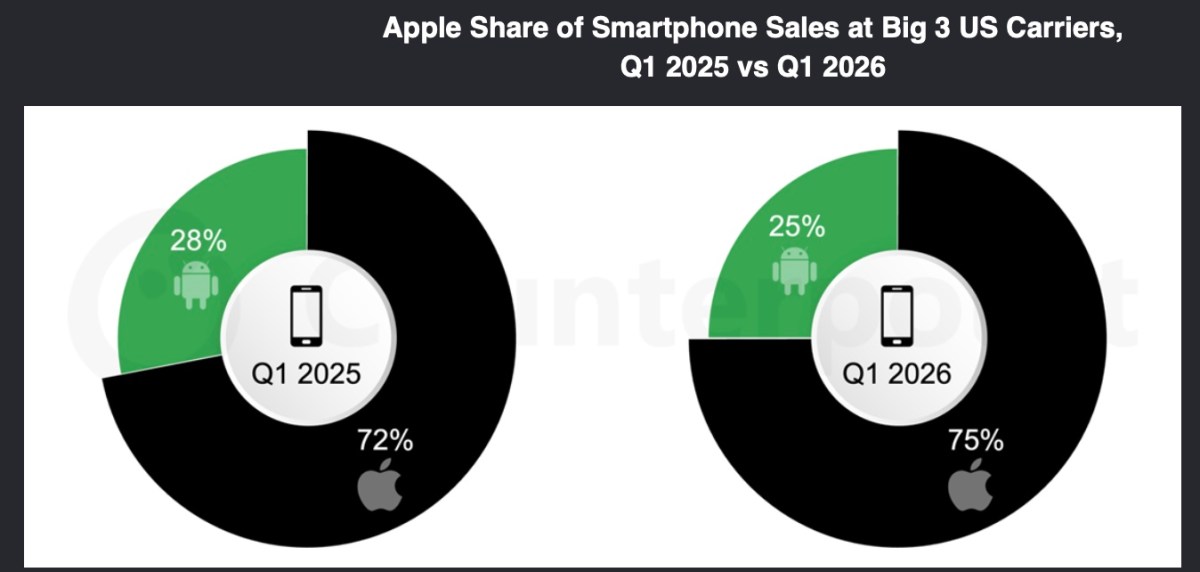
Apple’s quarter one (Q1) 2026 iPhone sales volume in the US was up 1.3% year-over-year (YoY), outperforming the country’s overall smartphone market.
That market declined 5.7% YoY, according to Counterpoint’s US Monthly Smartphone Channel Share Tracker. Apple’s share of volume grew by 4% YoY, as Android device sales declined 14.4% YoY.
Counterpoint Senior Analyst Tyler Graham said Apple’s success was driven by the iPhone 17 series, which experienced carryover demand from supply limitations in the fourth quarter of 2025 due to global demand for the latest iPhone lineup. Besides, the base iPhone 17 model saw higher demand than expected, causing Apple to recalibrate its production mix, he added.
Apple also benefited from the later launch of Samsung’s Galaxy S26 series in Q1 2026. Samsung delayed the launch until mid-March this year, leaving somewhat of a vacuum in the premium space for an extra month in Q1.
On the impact of the delayed launch,Graham said, “The premium smartphone space in the US is highly consolidated compared to some other markets, with Apple, Google, Samsung and, to some extent, Motorola comprising the vast majority of sales here. When one brand delays a flagship launch, it opens a window of opportunity to fill that vacuum. Apple did just that.”
Apple grew its market share in each of the Big 3 US carriers. Its share grew the most at Verizon to 77% in Q1 2026.
Counterpoint says the 5.7% YoY decline for the overall US market in Q1 2026 was driven by two main factors: later-than-usual flagship launches and low-end weakness. The first was the delayed launch of both the Galaxy S26 series and the iPhone 17e. The later Galaxy S26 and Apple iPhone 17e launches skewed YoY comps in Q1 and will also impact Q2 comparisons.
As for low-end weakness, Senior Analyst Maurice Klaehne said, “Tax season is a big event for the prepaid space in the US. It helps provide a boost to unit sales in the lower end of the market. This year, that was not the case.”
Low-end weakness was driven largely by macroeconomic headwinds. Lower-income households did see tax return increases YoY, albeit not as much as high-income households on a percentage basis. What’s more, these tax return increases were offset by inflated gas prices, even as many consumers opted to use that money to pay credit card bills. As a result, more money transfers to lower-income households YoY did not translate into the expected lift in smartphone sales in the prepaid segment, notes Counterpoint.
Amid lower overall sales in the low end, especially in the sub-$100 price band, prepaid channel marketing spend is consolidating around Motorola and Samsung. Other players in lower price bands, like TCL and HMD, have put off model refreshes or exited the market or are having a tough time keeping up with the marketing power of Motorola and Samsung. As a result, Motorola and Samsung grew their market share in most prepaid and national retail channels in Q1. Cricket (Samsung +6% points; Motorola +6%points) and Metro (Samsung +2% points; Motorola +7% points) were two channels with significant shifts YoY.
Consolidation in the low end is expected to continue in the US as rising memory costs impact smaller players like Maxwest, Orbic and Blu, as well as white-label devices. Shrinking margins may force a reduction in portfolio diversity in lower price bands and further push lower-income consumers towards Samsung and Motorola options.
Meanwhile, Apple has maintained its pricing strategy, keeping the iPhone 17e pricing consistent YoY while increasing the entry-level storage to 256GB, even as peers introduce price hikes. With this strategy, Apple hopes to draw more users into its iOS ecosystem, while placing service revenue growth over hardware profitability in the US and elsewhere.
Counterpoint thinks this will lead to faster revenue growth through 2027. For manufacturers with smaller hardware margins, it will be tough to keep pace with Apple’s consistent pricing and marketing spend at the US carriers, opines the research group.
Through Q1 2026, Apple outpaced Samsung in Counterpoint’s average Smartphone Promotional Index scores across devices priced $600 and above in US postpaid channels. Apple increased its promotional power in this segment YoY in Q1, as did Motorola and Google, while Samsung declined.
“If Apple can avoid significant price increases and continue to outpace its peers in promotional dollars, it will be tough for Android manufacturers to keep up in the year ahead, said Klaehne.
I hope you’ll help support Apple World Today by becoming a patron. Almost all our income is from Patreon support and sponsored posts. Patreon pricing ranges from $2 to $10 a month. Thanks in advance for your support.
Also, check out my daughter-in-law’s “Scattered Words” website if you’re interested in unique, handcrafted jewelry made out of an array of vintage dictionaries, books, and even a few antiques.
Article provided with permission from AppleWorld.Today