
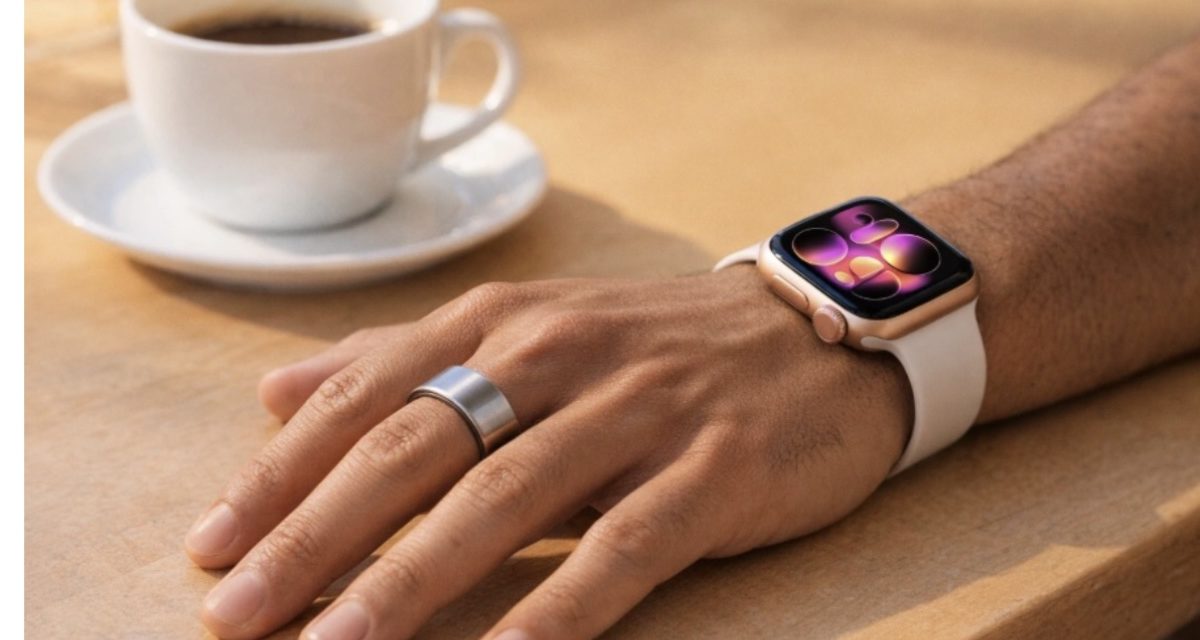
I wore an Apple Watch Series 11 and an Oura Ring 4 together for three months. Not because I needed two wearables — nobody needs two wearables — but because I was tired of choosing between them.
The Watch is brilliant on my wrist during the day, but sleeping in it felt like wearing a small computer to bed. The ring promised better sleep data in a form factor I would actually forget I was wearing. So I tried both.
Here is what I found.
Why Bother With Two Devices?
The honest answer: charging anxiety and sleep tracking frustration. My Apple Watch would die mid-afternoon if I wore it overnight, and even when I did track sleep, the data felt shallow compared to what ring users kept bragging about online. I wanted 24/7 body data without babysitting a single device’s battery. The Oura Ring 4 seemed like the natural complement — small, passive, and designed around the metrics the Watch handles least gracefully. I settled on the Oura after reading through a smart ring comparison covering the current options, and it came down to sleep tracking accuracy and app quality.
Where the Ring Wins
Sleep. It is not even close. The ring sits on your finger, weighs almost nothing, and has no screen lighting up when you roll over at 2 a.m. Within a week I stopped noticing it was there. Oura’s sleep staging felt more consistent than what the Watch reported — my deep sleep numbers aligned better with how rested I actually felt in the morning.
The morning readiness score became my favorite feature. Before I even got out of bed, I had a single number telling me whether to push hard at the gym or take it easy. The Watch gives you similar recovery hints buried in the Health app, but Oura puts it front and center the moment you wake up.
Battery life is the other big win. I charged the ring every five or six days. That meant it was always on, always tracking — resting heart rate, HRV trends, body temperature — without me thinking about it.
Where the Watch Wins
Everything that involves doing something. Workouts, navigation, payments, music — the Watch is unmatched here because it has a screen and GPS and an entire app ecosystem behind it.
For running specifically, the difference is enormous. Real-time pace, cadence, heart rate zones, route mapping through Strava — none of that exists on a ring. The Series 11 locks onto GPS faster than any Watch I have owned, and the motion sensors pick up ground contact time and stride length automatically. If you want the full picture of how the latest hardware handles run tracking, the Series 11 is a genuine step up from previous generations.
Beyond fitness, the Watch handles Apple Pay, notification triage, quick replies, podcast playback, and turn-by-turn directions. A ring cannot do any of that. It is a passive sensor, not a wrist computer.
The Surprising Overlaps — and Disagreements
Both devices track resting heart rate and HRV. Both count steps. Both log activity. And they almost never agree on the exact numbers.
My resting heart rate from the ring was consistently two to three beats lower than what the Watch reported. After digging into it, this makes sense — the ring measures from the finger artery with less motion noise, and it samples during sleep when I am truly at rest. The Watch often grabs its “resting” reading during quiet moments in the day, which are not quite the same thing.
Step counts diverged too, usually by 500 to 1,000 steps. Wrist-based counting picks up arm movements that are not actually steps; finger-based counting misses steps when your hand is in your pocket. Neither is wrong. Neither is perfectly right.
HRV told the most interesting story. The trends moved in the same direction — stressful week, both dropped; restful weekend, both climbed — but the absolute numbers differed enough that I stopped comparing them directly and just watched each device’s own trendline. Apple explains its HRV methodology in the watchOS documentation if you want to understand the difference.
Is It Worth Wearing Both?
For me, yes — but I am the exact target audience for this kind of setup. I run four times a week, I care about sleep quality, and I find longitudinal body data genuinely useful for adjusting training load. The ring owns the night and passive daytime monitoring. The Watch owns workouts, interactions, and everything that benefits from a screen.
If you are a casual fitness user who closes their rings and checks the occasional notification, a second device is overkill. One Apple Watch does everything you need. But if you have ever been frustrated that your Watch dies before bedtime, or that your sleep data feels like an afterthought, adding a ring fills exactly that gap.
The two devices do not talk to each other — there is no sync, no shared dashboard — so you end up checking two apps. That is the real cost. Not the money, but the cognitive overhead of maintaining two separate data streams. For data nerds, that is half the fun. For everyone else, it is a reason to pick one and commit.
My setup now: Apple Watch during the day, ring 24/7, Watch on the charger at night. Three months in, I have not gone back.
Article provided with permission from AppleWorld.Today