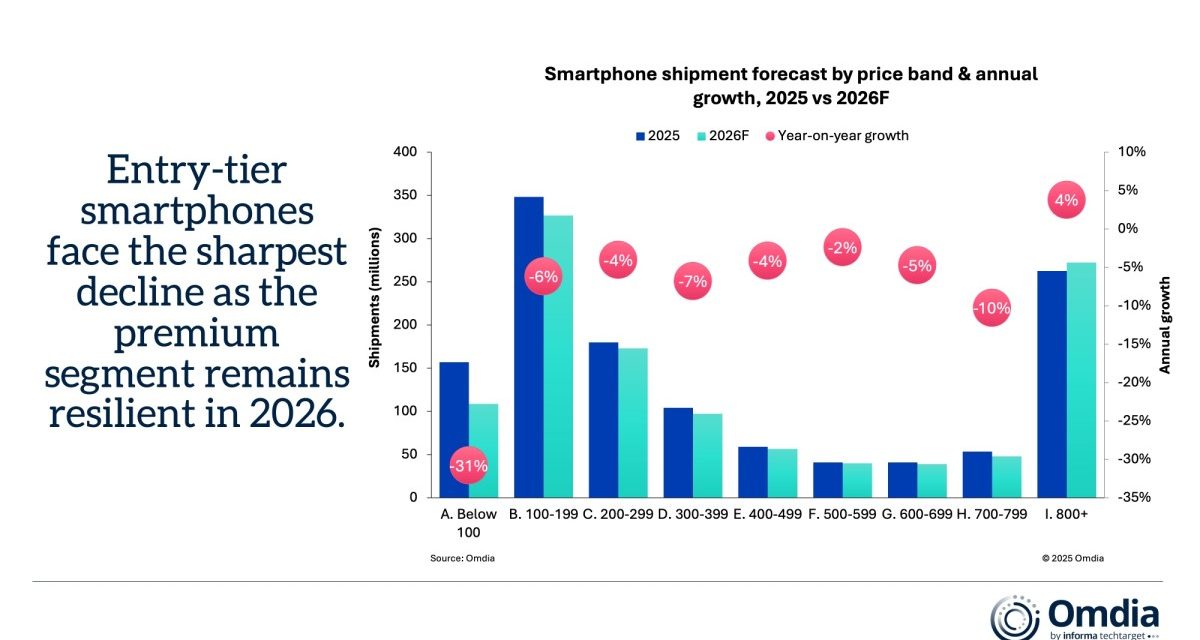
Global smartphone shipments are forecast to decline by around 7% year-on-year in 2026 according to Omdia’s latest outlook. But it’s not all bad news for Apple.
The research group’s projection is based on quarter one memory price assumptions, which indicate that pricing pressure and constrained supply will begin to ease in the second half of the year. Still, the global smartphone market will face significant challenges in 2026 as tightening memory supply and elevated pricing place increasing cost pressures for vendors, according to Omdia.
Memory now accounts for a significantly larger share of the smartphone bill of materials (BOM), eroding vendor profitability, particularly in entry-level devices. Since 4Q25, smartphone manufacturers have already begun raising retail prices in order to maintain profit margins. However, sustained price increases are likely to weaken demand, particularly in price-sensitive emerging markets, according to Omdia.
What’s more, further memory pressure and geopolitical volatility raise the risk of over 15% smartphone shipment decline in 2026, adds the research group:
From the report: Downside risks to the forecast remain significant. If memory prices continue rising into the second half of 2026 due to tight supply and increasing AI server demand locking in production capacity, smartphone vendors will face further cost escalation across both entry-level and premium devices. At the same time, escalating geopolitical tensions in the Middle East could amplify macroeconomic volatility including higher energy prices, freight costs, and foreign-exchange instability, further weakening consumer upgrades in price-sensitive markets. Under this downside scenario, global smartphone shipments are expected to decline by more than 15% in 2026, potentially exceeding the 12% contraction recorded in 2022.
However, the premium segment is expected to remain relatively resilient despite rising component costs. Devices priced above $800 are forecast to grow by around 4% in 2026, supported by stronger brand positioning and greater pricing flexibility.
“Apple maintains a dominant presence in the high-end market and benefits from strong supply chain relationships and higher margins that help absorb component cost inflation,” said Omdia Principal Analyst Zaker Li.
I hope you’ll help support Apple World Today by becoming a patron. Almost all our income is from Patreon support and sponsored posts. Patreon pricing ranges from $2 to $10 a month. Thanks in advance for your support.
Article provided with permission from AppleWorld.Today