


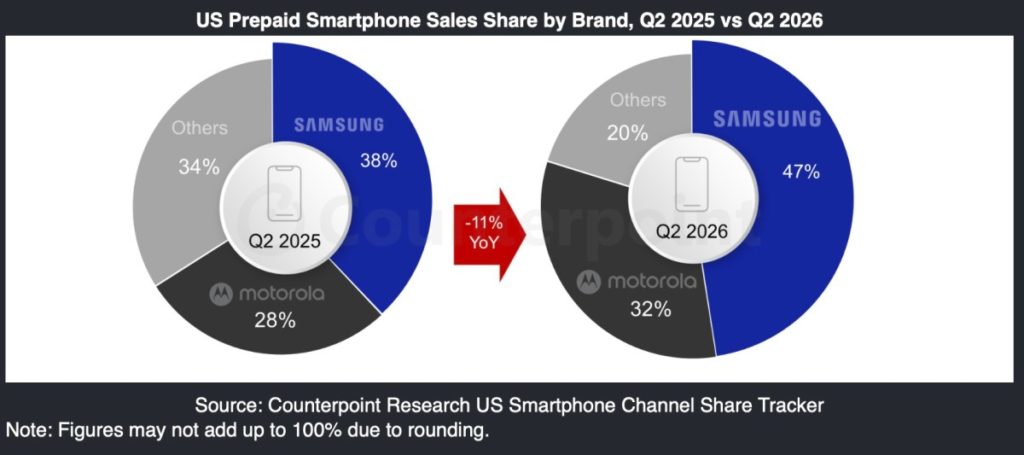
US smartphone sales fell by 5% year-over-year (YoY) in quarter two (Q2) of 2026 as memory price hikes and other macroeconomic factors weakened consumer demand, according to Counterpoint’s US Smartphone Channel Share Tracker Monthly Report.
Consumers were hit on two fronts in the quarter, notes the research group. Price increases for gas and other goods due to conflicts in the Middle East affected purchasing power for smartphones and other electronics. Rising RAM demand from hyperscalers has also increased memory costs significantly for smartphone manufacturers. Counterpoint says this has disproportionately affected the low end of the smartphone market, where thinner margins have made the situation more difficult to navigate.
Cumulative sales for the Big Four Manufacturers in the US market (Apple, Samsung, Motorola, Google) fell 4% YoY in Q2 2026. The rest of the market fell by 45% as smaller manufacturers struggled to navigate component cost increases. Counterpoint says the larger players have been able to use leverage of scale to acquire component inventory that smaller brands have been unable to access at justifiable costs. The tariff fears and weak prepaid market in 2025 had already driven several smaller brands to leave the US market or downsize their operations.
The most notable of these was HMD, which exited the US market last year. Now the pricing crunch for memory and storage has further complicated business for a lot of smaller manufacturers that sell devices at lower prices and lower margin.
Consequently, sub-$100 smartphone sales declined 64% YoY in Q2 2026 as smartphone makers either stopped shipping these devices or were forced to increase prices to offset increased memory costs. Carrier-branded white-label smartphones have faced some of the largest declines as price crunches have narrowed the price gap between white labels and the pricing that larger companies ike Samsung and Motorola are able to provide.
Although prepaid sales in the US declined 11% YoY in Q2 2026, Samsung and Motorola increased their share of prepaid sales as they capitalized on weakness and market exits by other low-end manufacturers during the pricing crunch. Carriers have leaned on Samsung’s Galaxy A Series and Motorola’s Moto G Series models to attract switchers in the changing prepaid market. Counterpoints expects smartphone ASPs [average selling prices] to continue to increase in the third quarter of 2026, as Apple is expected to increase prices for its iPhone 18 series models.
From the report: Given that Apple historically accounts for over 50% of smartphone sales in the third quarter, price increases for top models will have a large effect on smartphone ASPs. Sales strength will be dependent on how much the carriers are willing to subsidize these models. Apple is expected to have a strong upgrade cycle with users switching from the iPhone 15 series. If carriers can continue offering these models for free, or close to free despite the price increases, sales should remain strong.
I hope you’ll help support Apple World Today by becoming a patron. Almost all our income is from Patreon support and sponsored posts. Patreon pricing ranges from $2 to $10 a month. Thanks in advance for your support.
Article provided with permission from AppleWorld.Today