


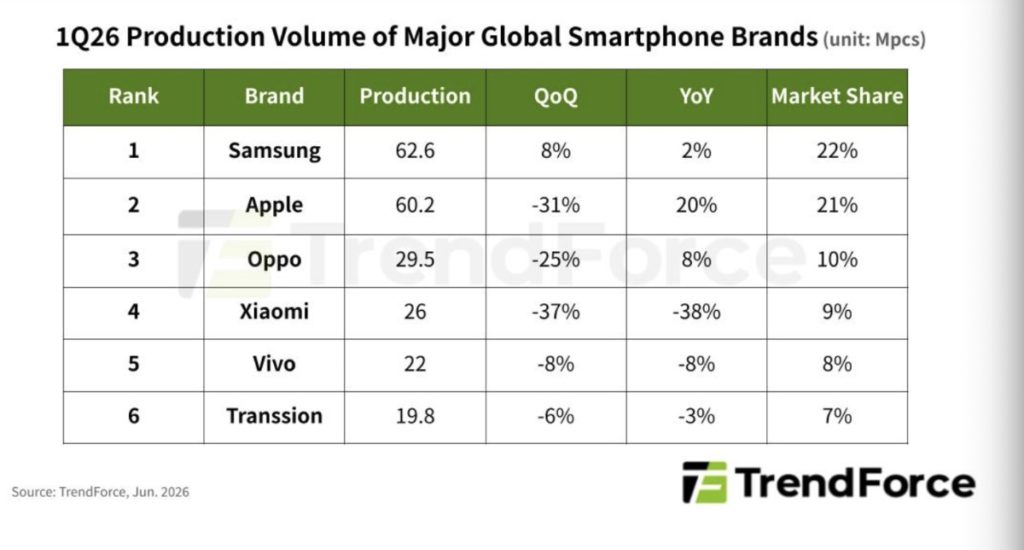
TrendForce’s latest figures reveal that global smartphone production reached around 284 million units in the first quarter of 2026, marking a 1.7% year-over-year decline.
Despite a sharp rise in memory prices since the second half of 2025, the effect on production was minimal because brands still held inventories of cheaper memory components, the research group says. Additionally, consumer expectations of higher prices in the future have helped sustain short-term demand, cushioning the impact of rising memory costs on production during the quarter.
However, TrendForce says that, as low-cost memory supplies are gradually exhausted and significant ongoing increases in memory prices reduce profits, most smartphone brands have begun adjusting production in the second quarter.
Looking ahead, the research group forecasts global smartphone production to decline approximately 16.2% year-over-year to 1.051 billion units in 2026. Under a more severe scenario, the annual decline could become even more pronounced if memory price increases remain elevated and brands are forced to raise retail prices repeatedly, adds the research group.
Smartphone vendors are adopting different strategies to overcome the challenges. For instance, brands with strong premium pricing power and broader group-level financial resources are more likely to maintain or expand market share. Meanwhile, Chinese brands focused on the mid-range and entry-level segments are following more conservative production plans due to mounting pressure from rising costs and intensifying competition from Huawei.
Samsung remained the world’s largest smartphone producer in the first quarter of 2026, with output reaching approximately 62.6 million units. TrendForce says the company is relatively well-positioned to withstand the current cost inflation cycle thanks to strong financial backing from the broader Samsung Group and a sizable premium product portfolio. Nevertheless, its significant exposure to lower-end models remains a concern—particularly amid weakening consumer sentiment—making end-market demand a key factor to monitor.
Apple ranked second with its production of approximately 60.2 million units during the quarter. In addition to ongoing production ramp-up for new iPhone models, output was supported by the launch of the iPhone 17e, resulting in 19.7% year-over-year growth.
Compared with competitors that have already entered a margin-protection phase, Apple remains better positioned to absorb higher memory costs while maintaining profitability, according to TrendForce. The research group believes Apple is more likely to prioritize market share expansion during the current downturn as it lays the groundwork for future growth in recurring software and services revenue.
I hope you’ll help support Apple World Today by becoming a patron. Almost all our income is from Patreon support and sponsored posts. Patreon pricing ranges from $2 to $10 a month. Thanks in advance for your support.
Also, check out my daughter-in-law’s “Scattered Words” website if you’re interested in unique, handcrafted jewelry made out of an array of vintage dictionaries, books, and even a few antiques.
Article provided with permission from AppleWorld.Today