


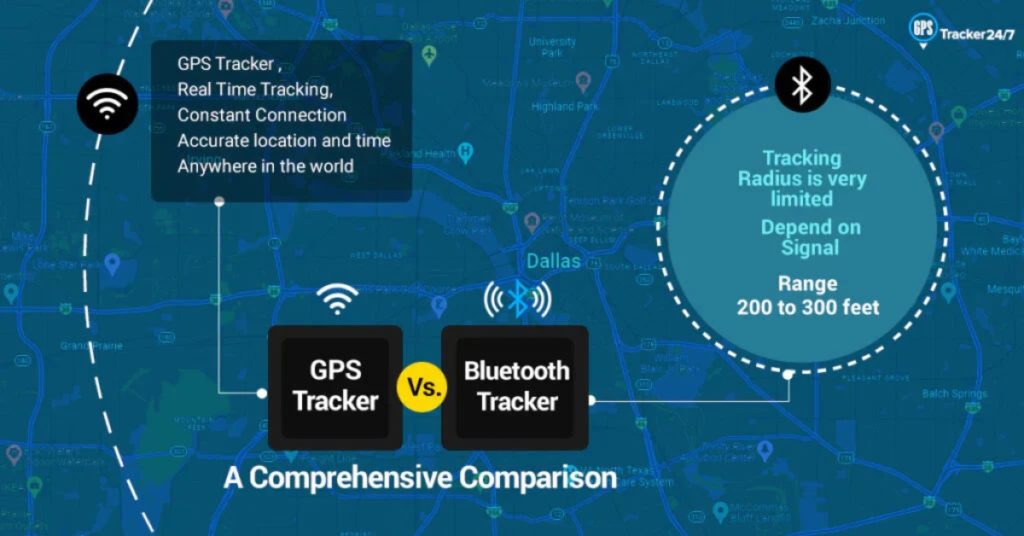
GPS trackers and AirTags look like they do the same thing. They don’t. One is a live-positioning tool; the other is a Bluetooth breadcrumb.
A GPS tracker talks directly to satellites orbiting 12,000 miles above the Earth. It gets coordinates every few seconds, then sends them through a cellular network to your phone. That means it works on the highway, at an airport, or even halfway across the country.
An Apple AirTag skips satellites entirely. It whispers a Bluetooth signal to nearby iPhones, which anonymously report its position to Apple’s Find My network. In a dense city, it feels like magic. In the desert, it’s just a coin with a beep.
That core difference—independent GPS satellites vs dependent Bluetooth relays—decides everything: cost, reliability, and use case.
How the Technology Really Works
GPS trackers win on autonomy; AirTags win on scale.
- GPS trackers pull real-time coordinates from up to 31 satellites in the U.S. GPS constellation, often combined with GLONASS or Galileo for extra precision.
- Those coordinates go through a 4G LTE SIM module, shooting your location data to a cloud dashboard or mobile app.
- AirTags use Bluetooth LE 5.0 with a range around 100–150 feet. When that signal touches another Apple device, it’s logged in the Find My network.
If you’re in New York, Los Angeles, or any iPhone-heavy city, an AirTag can update every minute. If you’re in rural Montana, that update might take hours—or never happen.
A GPS tracker, on the other hand, doesn’t care who’s nearby. As long as it sees the sky, it talks to satellites. That’s why GPS trackers sit under car dashboards, on dog collars, or inside checked luggage for travelers crossing continents.
Tech Features That Actually Matter
Range
A GPS tracker’s range is effectively planetary—limited only by cellular coverage if it needs to send updates. An AirTag’s range is crowdsourced, living or dying by how many Apple devices pass nearby.
Accuracy
GPS trackers nail 3–10 ft precision in open areas. AirTags hit 20–30 ft at best because Bluetooth signal strength and building interference skew results.
Battery Life
GPS devices trade battery life for performance: 2 weeks to 3 months depending on ping frequency. AirTags sip power slowly; one CR2032 coin cell lasts about a year.
Alerts and Smart Features
GPS trackers offer geofencing—instant notifications when something moves outside a defined zone. Many log speed, route history, and motion data. AirTags do separation alerts (“Your wallet is no longer with you”) and precision finding with iPhone 11+ using the U1 Ultra Wideband chip.
Privacy and Security
AirTags rotate Bluetooth identifiers every 15 minutes to prevent tracking abuse. iPhones detect unknown AirTags moving with you and alert you. GPS trackers don’t broadcast publicly but store movement data in cloud accounts, often secured by password and two-factor authentication.
Cost: The Real Price of Peace of Mind
AirTags are cheap. GPS trackers are serious hardware.
- AirTag: $29 each or $99 for four. No subscription.
- GPS tracker: $40–$120 device + $5–$20 monthly data plan.
Let’s do the math. A $100 tracker with a $10/month plan costs $220 in the first year. A four-pack of AirTags costs $99, total stop.
That’s why many parents and travelers pair them. They’ll throw an AirTag in their luggage but use a Family1st Portable GPS Tracker, Invoxia Cellular GPS, or Bouncie OBD tracker for vehicles and kids.
The extra $10/month buys something AirTags simply don’t have: global, real-time visibility.
Performance in the Real World
Testing both reveals the philosophical gap.
In a city, AirTags are brilliant. Leave your backpack in a café in Brooklyn, and 50 iPhones walk by in an hour. The Find My network updates constantly. Tap “Find Nearby,” and your phone points straight to it with an arrow.
Drive 40 miles out, and the updates fade. AirTags don’t “ping” on their own—they wait for help. If no Apple device crosses paths, your AirTag might as well be invisible.
A GPS tracker doesn’t wait. It logs position every 30 seconds and sends it to the cloud, rain or shine. Hiding one under your car seat means you can check its speed, route, and even stops in real time. That’s why delivery fleets, travelers, and parents use them for life safety—not just recovery.
Which One Fits Your Life
Pick based on movement and environment.
When it comes to tracking a car or teen drier, a GPS tracker is a better choice as it provides real-time updates, speed alerts and unlimited range.
When it comes to luggage or international travel, a GPS tracker is a better choice as it works outside iPhone network zones.
When it comes to a lost wallet in a city, the AirTag is the better choice as it’s compact, cheap, and effective via the Find My network.
When it comes to pet tracking in rural areas, the GPS tracker is the better choice as it has satellite precision and long-range connectivity.
When it comes to everyday keys and bags, the AirTag is the better choice as it has simple setup and zero subscription.
If it moves fast or far, GPS wins.
If it stays local and small, AirTag wins.
How to Set Up a Tracker the Right Way
Even pros make setup mistakes. Here’s how to do it cleanly.
- First, decide your tracking priority. Continuous movement (use GPS) or location recovery (use AirTag).
- Second, install and test. For GPS trackers, charge fully, insert the SIM, and place it where it sees the sky. For AirTags, pair via iPhone NFC and label each item clearly.
- Third, set alerts. In GPS apps, create geofences. In AirTag settings, enable “Notify When Left Behind.”
- Fourth, test weekly. Move each device and confirm app notifications and position accuracy.
- Fifth, maintain power. Recharge GPS units or replace AirTag batteries yearly.
Smart setup determines whether your tracker actually saves you when you need it most.
Common Mistakes and Fixes
- Putting a GPS tracker inside metal compartments. Satellite signals need exposure—place it under plastic or glass.
- Assuming AirTags work everywhere. They rely on nearby Apple devices; airports and rural highways often have gaps.
- Forgetting SIM data plans. GPS trackers go offline without active service.
- Skipping app calibration. Update firmware and re-sync location permissions for precise mapping.
- Ignoring privacy settings. Review AirTag “Item Safety Alerts” or GPS sharing permissions regularly.
FAQ
Are GPS trackers more accurate than AirTags?
Yes. GPS uses satellite triangulation with up to 3-meter precision; AirTags estimate distance via Bluetooth signal strength.
Do AirTags work in real time?
No. They refresh location only when detected by another Apple device.
Do GPS trackers need the internet?
They transmit data over cellular networks; without service, they log coordinates for upload later.
Can Android users track AirTags?
Only partially. Android phones can detect unknown AirTags nearby via Google’s Unknown Tracker Alerts, but they can’t pair or locate owned tags.
How long does a GPS tracker last?
Between 14 and 90 days per charge, depending on settings. Hardwired models run indefinitely.
Expert Verdict
If you want to know where something is right now, buy a GPS tracker.
If you just want to find something you misplaced, get an AirTag.
Think of GPS as a live camera feed of your stuff. Think of AirTag as a motion detector that wakes up only when someone walks by.
Both technologies are incredible at what they’re designed for—but only one replaces worry with certainty.
Article provided with permission from AppleWorld.Today